—A base for the stool beside the tub
On six current Kohler baths the flat on top of the rim runs 1-5/16″ to 2-15/16″ — the company’s own minimum flat for door figure, in its own specification sheets. The widest one in that set is under three inches, and if yours is a shower combination, that flat is where the door track goes.
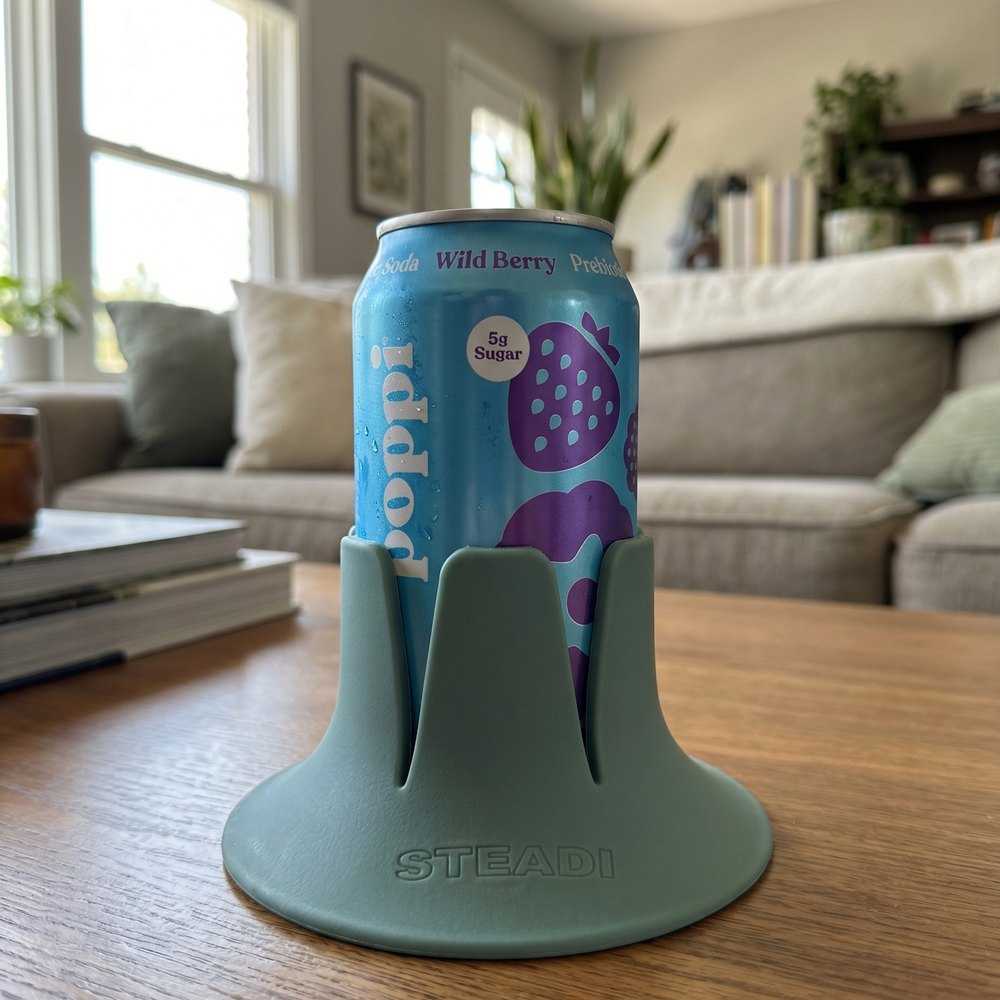
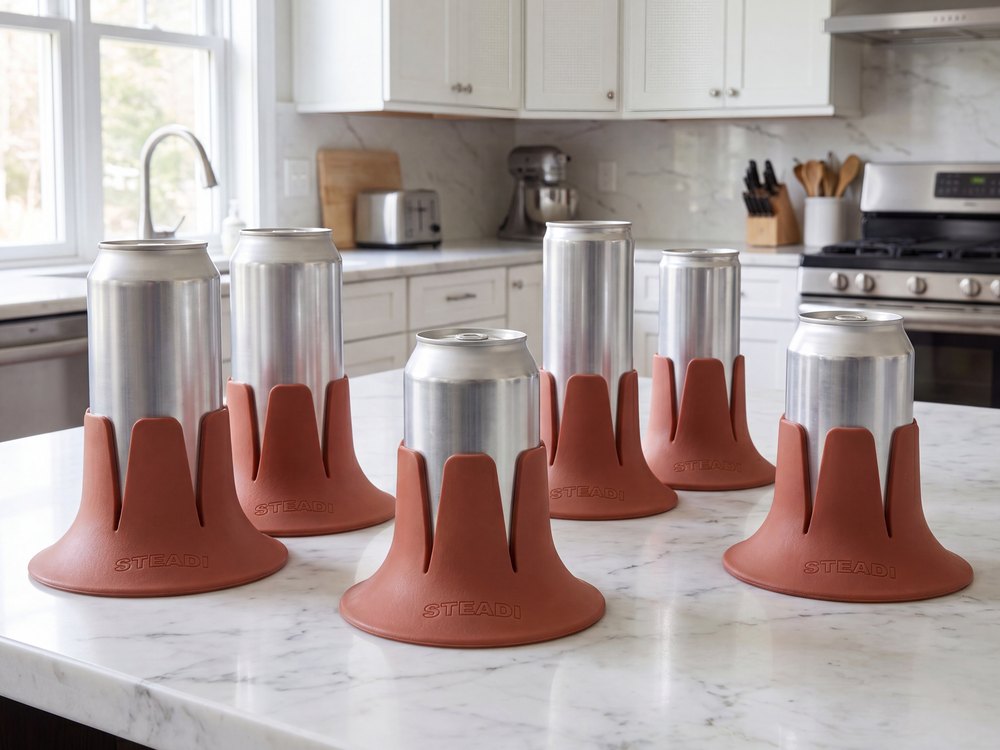
So the glass goes on it anyway, and you spend a third of your ten quiet minutes half-watching a glass. This is a 5.2″ base for the flat spot beside the tub instead — the stool, the side table, the closed lid.
4.9 average · 121 reviews
See the packsfrom $14.95 · free shipping on every order
Ships from Orange, California. 90 days to change your mind, wet hands and all.
—Read this before anything else
American Standard describes the edge of its Princeton alcove bath — $1,022 on americanstandardbathing.com, captured 4 September 2026 — as an “integral 3-sided tile/water retention flange.” Retention. The name is the job: hold the water inside the vessel, and give the tile something to lap onto. Three-sided is the other half of it — an alcove bath is buried on three edges, so the only rim you can reach is the front one.
And Kohler prints how much flat there is. Most of its bath specification sheets carry a line in the Technical Information block called Minimum flat for door. It is a shower-door fitment figure — the Villager sheet lists four sliding bath doors under recommended accessories — and incidentally it is the most useful number in the bathroom. Three of the six, from Kohler’s own sheets:
1-5/16″
cast iron, 60″ × 32″
Thirty-three millimetres of level. The narrowest published flat in the set.
1-7/8″
“Our most popular bath”
30-1/4″ wide overall, 24″ of water opening at the top. So 3-1/8″ of tub each side, and only 1-7/8″ of it flat.
2-15/16″
the widest in the set
The most generous flat of the six, and still under three inches across.
$14.95
no rim required
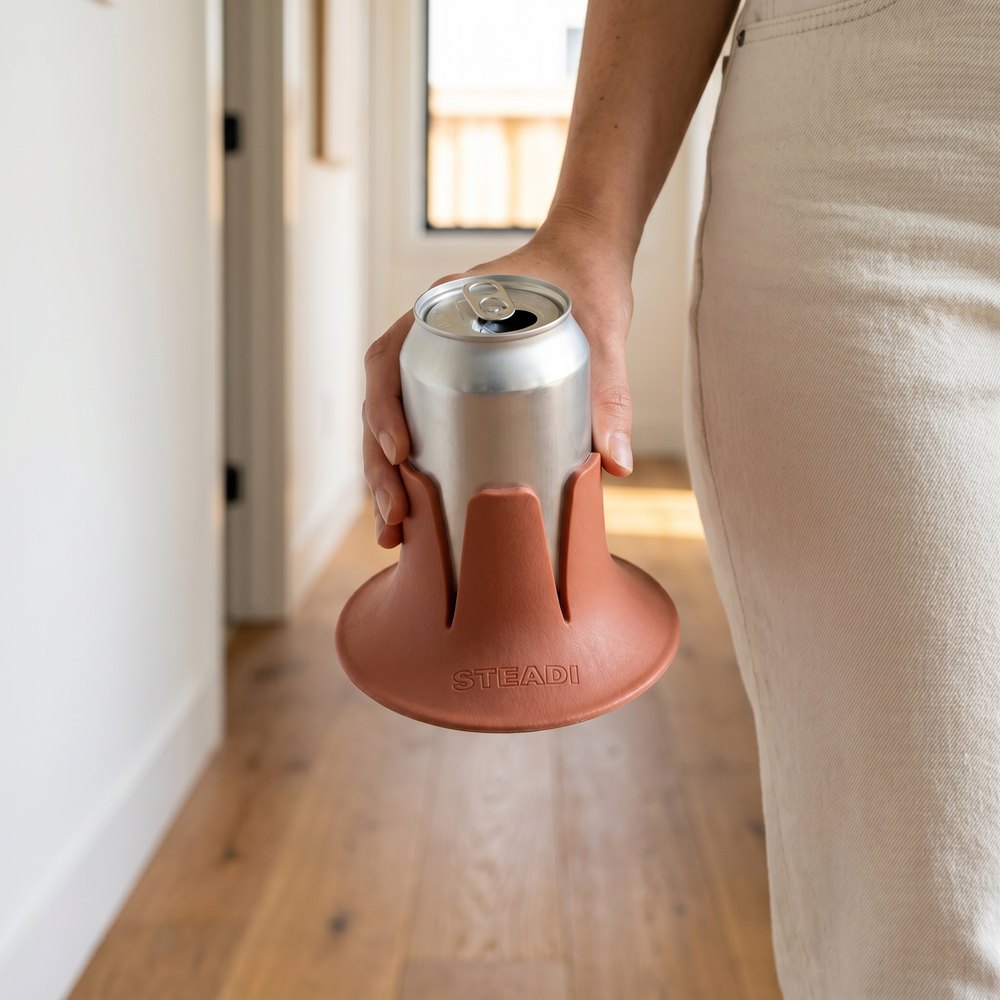
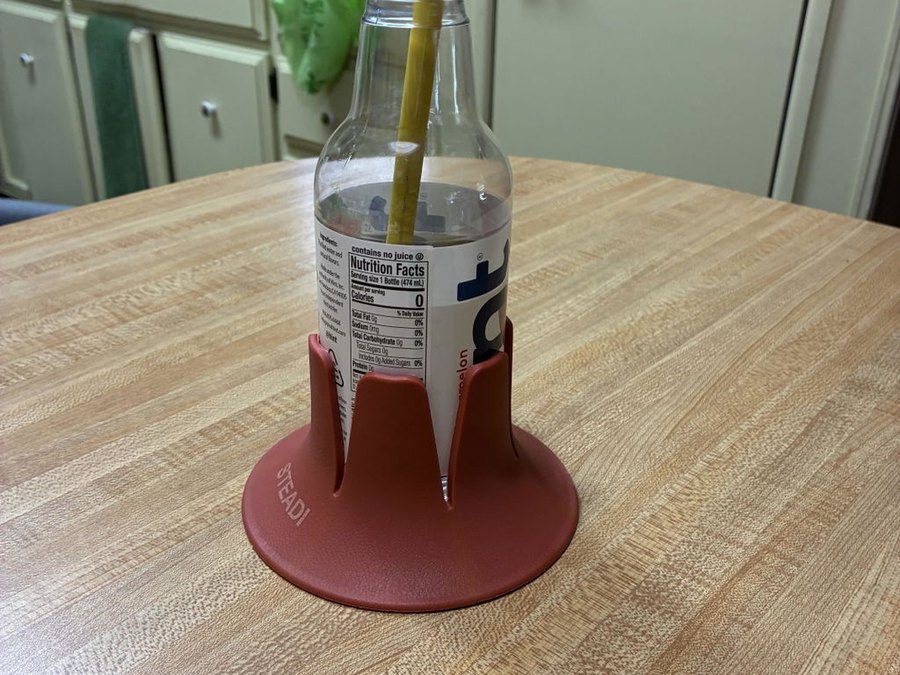
A 5.2″ moulded base, about 3.6 ounces, that the glass stands in — on a flat spot near the tub rather than one on it.
The Archer drop-in fills in at 2-1/8″, the Archer alcove at 2-9/16″ and the Underscore at 2-13/16″. Then there is the Expanse (K-1100), a 60″ × 32″ alcove with a curved basin: its published basin area at the top is 54″ × 31″, inside a tub 32 inches wide overall. That is roughly half an inch of rim on each long side, and its sheet lists no minimum flat at all.
Two things fall out of that, and the first one costs me money. A 5.2-inch base does not fit on any of them. The base is fixed — it does not fold, expand or narrow — so this is not a rim product, and you will not find one photograph of it balanced on a rim anywhere on this page. And if your tub is a shower combination with a sliding door, that flat is already spoken for. The track is sitting on it.
Sources: resources.kohler.com published specification sheets K-505, K-716, K-1123-LA, K-1946, K-1957-LA, K-26109-LA and K-1100-RA · americanstandardbathing.com Princeton listing. Fetched 4 September 2026.
—The tell that this is real
Read that again, because it reframes the whole bathroom. The recessed niche, the tiled seat, the curb — the room’s only engineered horizontal surfaces — are ramps by handbook. Nothing horizontal near water is permitted to hold water. That is the most consistent principle in the space, and your glass is on the wrong side of it.
The CDC counted what all of that is for. In its analysis of 2008 emergency-department data, “an estimated 234,094 nonfatal bathroom injuries were treated in U.S. EDs” among people aged 15 and over. Falls caused 81.1%. The highest injury rate by location was in or around the tub or shower. And the line that explains the entire design language of the room: “Only 2% of injuries occurred while getting into the tub or shower, when bathroom fixtures and floors likely would be less slippery.”
Dry, it is a room. Wet, it is the one every standard in the house is aimed at. Not one of those standards was ever asked to give you somewhere to put a glass, and none of them is going to be. The room is doing its job well. The job is simply not the one you needed.
Sources: tileletter.com (National Tile Contractors Association, citing the TCNA Handbook) · daltile.com on ANSI A137.1 and ANSI A326.3 · CDC, MMWR 2011;60(22). Fetched 4 September 2026.
—Does it actually work
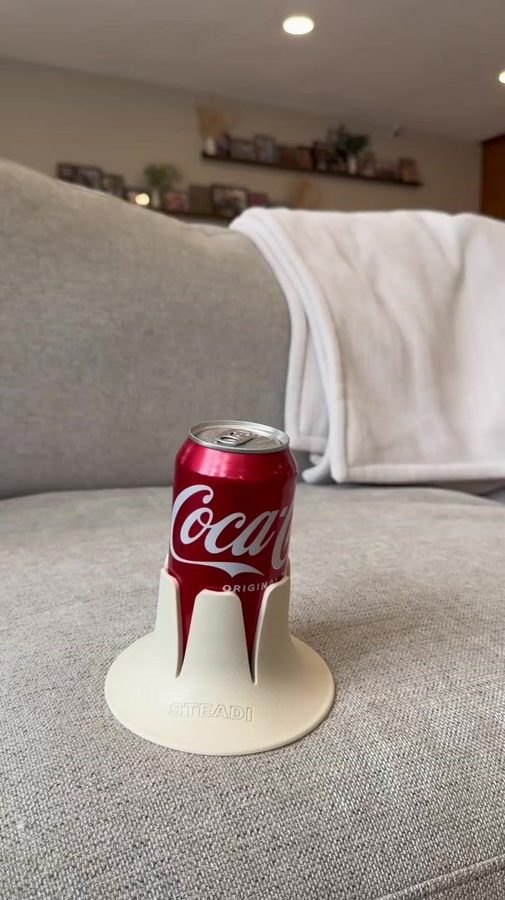
Somebody sits down beside it and the drink comes back level. The base is 5.2 inches across, and the whole thing has to lean a long way before it goes over.
Filmed on a couch cushion — not in a bathroom, and with no water anywhere near it. That is the honest footage we have, and a cushion is the harder surface rather than the flattering one. What it does not show is a wet room, so read the limits below before you decide.
—Why width, and nothing else
A suction holder works by seal. A bridge tray works by span. This works by neither. It puts a wide foot underneath a drink that was standing on its own small bottom, and that is the entire mechanism.
Ball Corporation’s product standard gives the body outside diameter of a standard 12 oz can as 2.600 in, plus or minus .008. The base of this is 5.2 inches — exactly twice that. The drink’s centre of mass has to travel much further sideways before it clears the edge of its own support, so tipping takes a far bigger tilt than it does on the can’s own bottom.
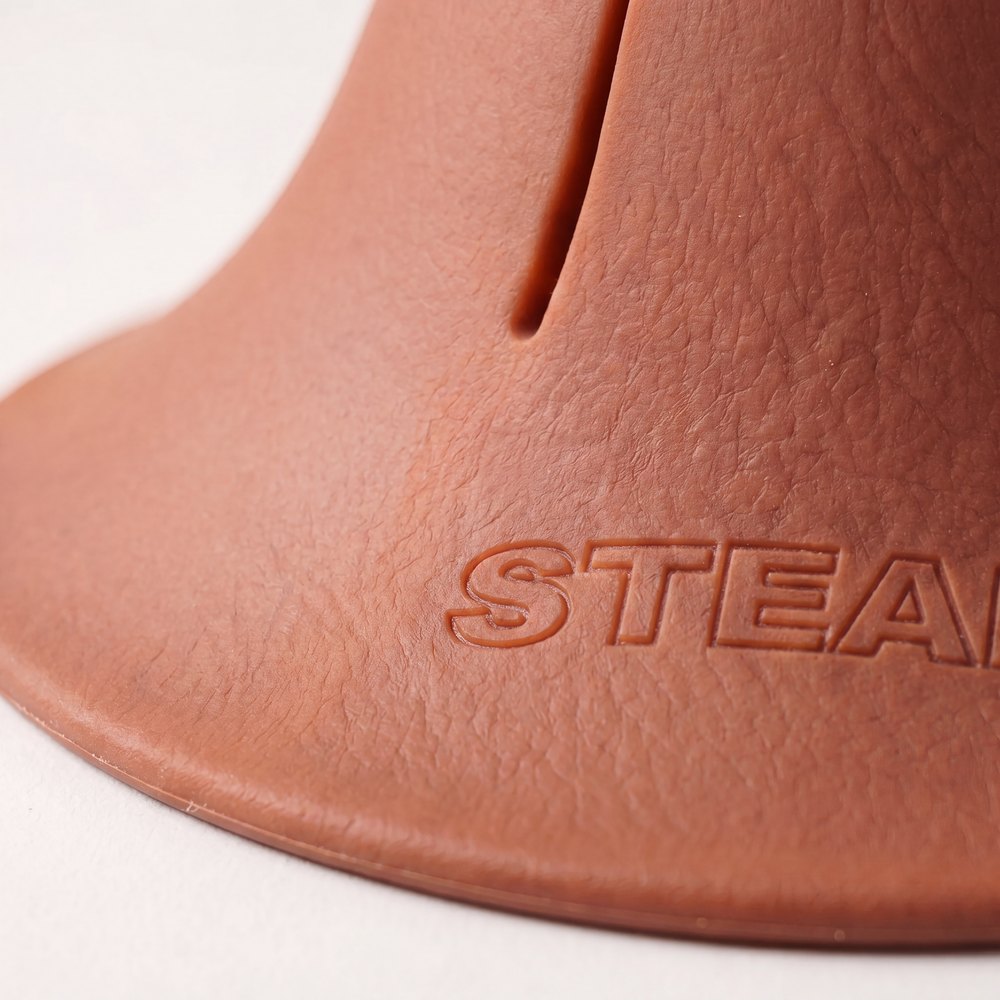
The tack of the thermoplastic polyurethane is the other half. It resists a cold glass creeping across a painted stool or a tiled deck, which is exactly what a sweating glass on a slick surface wants to do.
It resists tipping. It does not prevent it. A knee or an elbow that catches a full glass still wins, and nothing that is not bolted down changes that.
—The object
Top-rack dishwasher safe, or rinse it under the tap and stand it up. 100% BPA free.
—What seats and what does not
A stemmed wine glass does not seat, and a handled mug does not seat. A stem is a thin post over a wide flat foot and there is nothing there for the fins to grip; a handle lands exactly where a fin needs to be. On a page about baths that matters more than it does anywhere else, because a stemmed glass of wine is what a great many people reading this are holding. If that is your drink, the tray further down is your product and this one is not. I would rather lose the sale here than have you find it out at the tub.
What does seat: a stemless glass, a tumbler, a can, a bottle, a handleless tea glass. A 40 oz Stanley Quencher at a published 3.1″ base seats; a 30 oz at a published 3.15″ is at the very top of the fin range and is worth checking on your own counter rather than guessing.
Every width below comes from a published specification, not from us. Where a spec is uncertain, the answer says so.
A width across the bottom of the glass, in inches.
A standard sticky note is three inches square. Stand the glass you actually use on one, on the kitchen counter, dry. Bottom of the glass inside the paper and the fins will take it.
Do that before you buy anything — mine included. Anything that overhangs, or anything borderline: hello@steadilabs.com reaches a person, and the answer will be honest either way, including a no.
The Quencher base diameters are Stanley’s own published figures, stanley1913.com, fetched 4 September 2026. Ball Corporation’s can standard is quoted above. Every width in the search box is a published specification with its own source; where a spec is uncertain the answer says so rather than guessing.
—Where it goes
A stool pulled up beside it. A small side table. The closed toilet lid. A deep windowsill. The tiled deck around a drop-in or garden tub — built by a carpenter rather than by the tub manufacturer, and usually the one genuinely generous flat surface in the room. A clawfoot with no ledge at all is not the hard case here; it is the ordinary one, because none of those spots were ever the tub.
Set it where you would set a candle, not in the splash zone. The tack of the material is doing real work and a film of soap on glazed tile takes some of that away. And it belongs beside the tub, not in it — this is a set-down base for a dry surface within reach, not something to float, park in the water or hang on the side of the bath.
Nothing is installed. No drilling, no adhesive, no 24-hour cure, nothing left on the tile when you move out — which matters if the bathroom is not yours to make holes in.
Twelve colours, one per unit, so it reads as part of the room rather than as something you put away before company comes.
—What the aisle costs
A bath tray spans the tub. The rim is narrow, but on the baths above there are two of them thirty to thirty-two inches apart, and a beam laid across them is wide, stable and out of the water. That is a better idea than anything you can stick to a wall. If what you want is a book and a stemmed glass of wine, it is a better idea than this one, and you should buy it.
Prices and requirements below were looked up on 4 September 2026, not estimated. Everything in the last column is the seller’s own published wording.
| The product | Price | What it asks of the bathroom |
|---|---|---|
| SipCaddy suction holder | Not captured | A completely smooth surface. Its own FAQ: “Rated at 7lbs for a completely non-porous surface” — “glass, mirror, glossy tile, ceramic, metal.” And: “It won’t work on matte paint, eggshell finishes, textured stone like travertine, or anything with slight texture.” |
| Sudski shower beer holder, by 30 Watt | $17.00 at Target | A shiny, glazed surface. The listing says it installs “without the hassle of suction cups, adhesives or wall mounts,” that it is “Not intended for use on stone and other unglazed tiles,” and to “Wait 24 hours before use.” |
| Bambusi expandable bamboo tray | $29.99 | Two rims to span, 29.5″ collapsed to 42.9″ extended. “100% Natural Bamboo with Water-Resistant Lacquer Finish.” Care: “Avoid soaking for long periods to preserve the natural bamboo finish.” |
| Umbra Aquala caddy | $60.00 | Two rims no more than 37 inches apart. That is where the arms stop. |
| Monsuri bamboo bath tray | $68.95 | Two rims, 29.4″ to 41.3″. “A slot cradles a wine glass.” Care: wipe dry, store flat, skip the dishwasher, no standing water. |
| Westminster Teak Pacifica | $183 | A tub opening 22 inches or wider. 30″ × 9″ × 1″, 100% Grade A plantation teak. |
| The Bathtub Cup Holder | $14.95 · four for $39.95, $9.99 each | A flat surface under it that is not the tub. A stool, a side table, a closed lid, a tiled deck. |
Three honest concessions, because this page is not the only right answer in the room.
If your drink is a stemmed glass of wine, buy the tray. It was designed around that exact shape — Monsuri says so in its own copy — and this will not hold it. If you have a glass shower door or glossy ceramic within reach of the tub, a suction holder will hold — on the surfaces its maker lists, and both of the ones above publish their lists honestly. And if your two rims are within a tray’s span and you do not mind a board across your chest, the tray is the better object. It is wide, it is out of the water, and it does the job the rim cannot.
What survives all three is a specific bathroom. A clawfoot or a freestanding tub with a rolled lip and no flat at all — Kingston Brass, a fixture manufacturer, on its own blog: “Often, freestanding and clawfoot tubs only have a small lip, which makes it impossible to keep soaps and bath items handy.” A tub whose rims sit further apart than a tray extends. A bathroom finished in matte or textured tile, which is most of the ones specified for grip. Or simply a bath you would rather not have a bridge over while you are lying in it. In every one of those the drink still has to go somewhere, and the somewhere is the stool.
Sources: sipcaddy.com FAQ · target.com (30 Watt Sudski listing) · bambusi.com · umbra.com · monsuri.com · westminsterteak.com · kingstonbrass.com. Prices are the sellers’ own, fetched 4 September 2026 and current as of that date. No SipCaddy price was captured on that date, so none is printed. Steadi Labs is not affiliated with any of them.

—Get one
Most people take two — one for the stool beside the tub, and one for wherever the first one keeps disappearing to. Free shipping on all of them.
Checkout is handled by Steadi Labs — the company that makes The Bathtub Cup Holder. Secure checkout at steadilabs.com. Free shipping on every order, and 90 days to change your mind, used is fine.
—From people who bought one
Verbatim, unedited, not filtered by rating. This is a slice of one product-wide corpus — reviews of the Steadi, not of this page. Nobody in it mentions a bath, a tub or a soak. The four below are here because three of them describe the same geometry this page is about — nowhere at the right height to put a drink — and the first one describes the limit.

★★★★★
What an amazing invention!
Sylvia Smith · 2026-06-12Photo from the buyerPhoto from the buyerPhoto from the buyerPhoto from the buyerPhoto from the buyerPhoto from the buyerPhoto from the buyer
★★★★☆
not as steady as I would like but it is working just fine. It does slide a little. Overall it was a good purchase.
Randee Kirschbrown · August 2026
★★★★★
As advertised and works great. If you don’t have a side table at the right spot for your couch or bed, this will solve your problem.
David White · May 2026
★★★★★
The design for this is amazing. Simple and highly effective. No longer worrying about knocking over my drink from the side table or setting down my drink on a picnic blanket.
Obsessed · July 2026
★★★★★
Steadi works very well in stabilizing my drinks on soft surfaces, like the couch or by the chair I use as a nightstand.
Marie Adams · July 2026
Sent in with their reviews. Tap any one to read it. Different rooms, different drinks, different colours — none of them staged by us.
The four-star is first on purpose. “It does slide a little” is the most useful sentence in the corpus for a bathroom, and burying it would be exactly the move that sold you the last thing.
—Read this before you buy, including the parts that cost us the sale
—Ninety days
Ninety days from delivery, used is fine, wet hands and all. If the stool turns out to be the wrong height, or the spot you had in mind turns out to be sloped, or your drink turns out to be a stemmed glass after all — send it back. If you have already spent money once on this problem, I would rather you not spend it twice.
—Who makes it
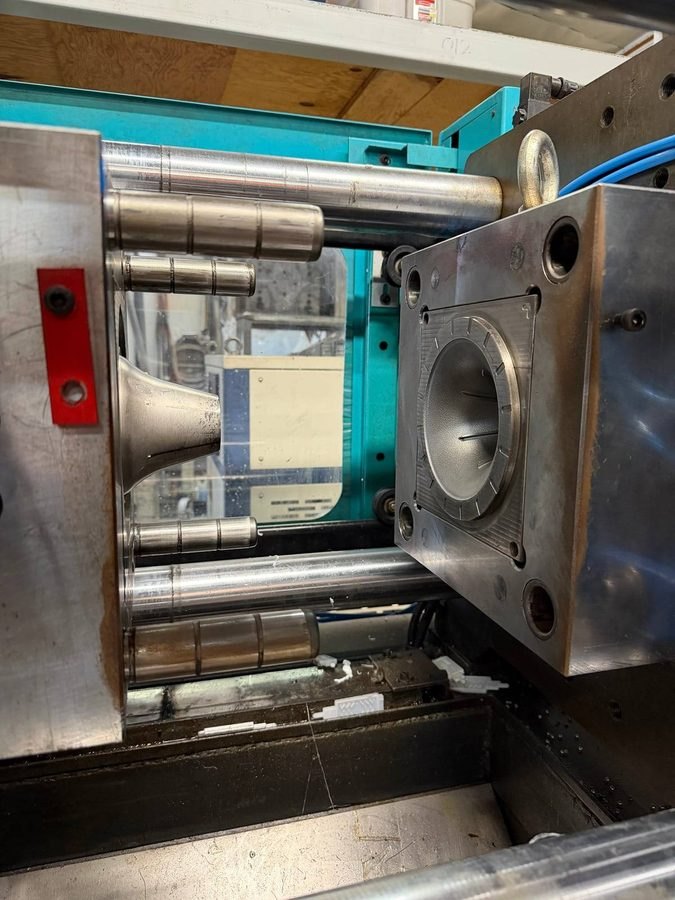
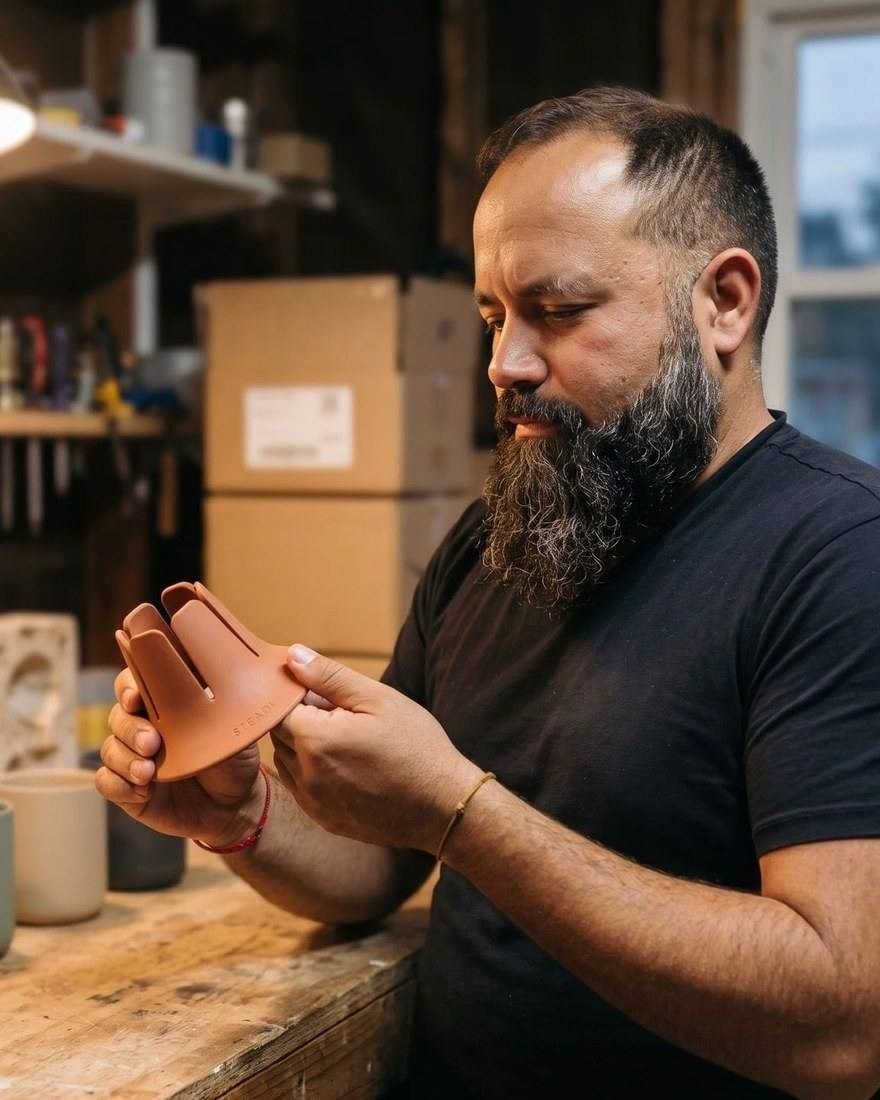
Scott made the first one after a full drink went over on a soft cushion, with three children under three in the house. Nobody with a clawfoot asked for this page. It exists because a wide foot does the same thing on a bathroom stool that it does on a couch cushion, and because everything it cannot do in a wet room is written above rather than left out.
—Asked and answered
That is the case it is actually for. It does not use the tub for anything. It needs a flat spot within arm’s reach — a stool, a small side table, the closed lid. Kingston Brass says the quiet part on its own blog: freestanding and clawfoot tubs “only have a small lip, which makes it impossible to keep soaps and bath items handy.” A tray needs two rims. This needs a stool.
No. The base is 5.2 inches and the widest published flat across six current Kohler baths is 2-15/16 inches. It would overhang on every one of them. This is not a rim product, and there is no photograph of it on a rim anywhere on this page.
If it is stemmed, no — a thin stem over a wide flat foot gives the fins nothing to grip. A stemless glass with a bottom under about three inches does seat; check it on a sticky note first. And if a stemmed glass is the point of your bath, buy the tray. Monsuri’s own copy says “a slot cradles a wine glass,” because that is what it was cut for.
Because it is a different object, not a better version of that one. A bamboo tray’s water resistance is a lacquer coat over slats: Bambusi’s own care line is “Avoid soaking for long periods to preserve the natural bamboo finish,” and Monsuri’s tells you to wipe it dry, store it flat, skip the dishwasher and keep it out of standing water. Those are the makers’ words, captured 4 September 2026. This is one moulded piece of TPU with no coating, no laminate and no glued joint, so there is nothing to wear through and no seam to open up. That is a difference in material, not a promise about your bathroom.
Nothing at all. No drilling, no adhesive, no suction cup, no 24-hour cure. It is set down and picked up, and it leaves nothing behind on the tile or the wall.
A 40 oz Quencher at a published 3.1″ base does. A 30 oz at a published 3.15″ sits right at the top of the fin range — check that one on a sticky note before you order.
Rinse it and stand it up to dry, or run it on the dishwasher’s top rack. It is one piece of TPU with nothing inside it. But it is meant for the dry flat spot beside the tub, not for the water, and I am not going to make claims about how it behaves in a full bath that I have not put on camera.
—Still deciding
The trays are good objects and they are not cheap: Bambusi’s is $29.99, Monsuri’s is $68.95, the Westminster Teak Pacifica is $183 — all from the makers’ own sites on 4 September 2026, all needing two rims within reach of each other and a wipe-dry routine to survive the room.
If your bath is a book and a stemmed glass of wine, that is the shape the slot was cut for and you should buy it. If your bath is a tumbler of iced tea, a can, a bottle or a glass of water, and there is a stool or a side table or a closed lid within reach — this is fifteen dollars and it does not care what your tub is shaped like.
The rim holds water in. The tile is specified for grip. The niche is pitched to drain. All of it points at the 234,094 bathroom injuries the CDC counted in a single year, and none of it was ever asked to hold your glass. That is not changing. You just do not have to spend a third of the bath half-watching one.
See the packsfrom $14.95 — free shipping on every order
90-day guarantee, used is fine · Made in Orange, California